

The global grinding and abrasives industry is undergoing a rapid technological transformation. Beyond material innovation, the most notable trends shaping the future of the sector include robotic grinding, CNC automation and smart factory integration, eco-friendly abrasives, and 3D-printed grinding tools. Grinding technology trends
These advancements are not only improving productivity and product quality but also helping manufacturers reduce operational costs and environmental impact, particularly relevant as Vietnam accelerates its path toward industrial modernization.
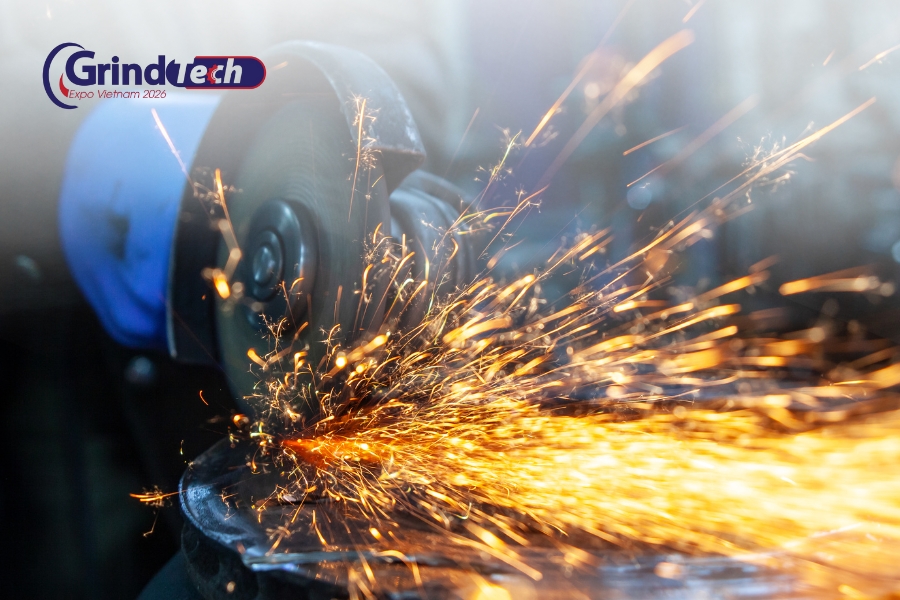
Grinding technology trends – Robotic Grinding & The Future of Automated Precision
Robotic grinding enables the automation of repetitive grinding tasks with consistent precision, minimizing manual errors and improving worker safety. Equipped with force sensors, 3D path programming, and integration with intelligent production systems, robotic grinding has become the new standard in factories requiring tight tolerances and high-volume output.
Market Outlook
According to recent market reports, the global robotic grinding market is valued at around USD 1.2 billion in 2024 and is projected to reach USD 2.8 billion by 2033, reflecting a double-digit CAGR over the next decade.
Industry Example
A notable collaboration between Saint-Gobain Abrasives (Norton) and United Grinding has produced integrated robotic grinding cells that combine advanced abrasives and precision machinery. These solutions optimize cycle times, extend wheel life, and demonstrate how tool and machine manufacturers can jointly advance automation in large-scale production.
Adoption Potential in Vietnam
In Vietnam, automotive, parts manufacturing, and precision engineering factories, especially those expanding to serve regional supply chains that can benefit significantly from robotic grinding.
Key advantages include:
- Reduced dependency on skilled manual labor
- Enhanced consistency and productivity
- Compliance with international export standards
The recommended approach is to pilot automation in large-scale or Tier-1 suppliers (companies providing critical components for OEMs in automotive, aerospace, and electronics), then scale to SMEs through robot-as-a-service models or pre-configured automation cells to minimize initial investment.
Grinding technology trends – CNC Automation and Smart Factory Integration
CNC (Computer Numerical Control) systems have long been the backbone of precision machining. When combined with industrial robots and intelligent control systems (PLC/IoT), CNC automation forms the foundation of smart manufacturing lines, allowing real-time monitoring of productivity, quality, and energy efficiency.
Industry Trends
Across ASEAN, particularly in Vietnam, investment in CNC machines and automation is growing rapidly. Market research indicates the CNC machine tools sector in Southeast Asia is expanding at a CAGR of 7-9% (2024-2030), reflecting a strong regional shift toward Industry 4.0 and digitalized production.
Leading Manufacturers & Solutions
Top global brands such as DMG MORI, Fanuc, Okuma, and Yamazaki Mazak are pioneering CNC–robot integration, delivering fully automated work cells that handle loading, grinding, inspection, and data management.
These systems are complemented by software that optimizes machining cycles, reduces tool change time, and ensures high repeatability.
Application in Vietnam
This technology is especially relevant for precision part manufacturing, including molds, shafts, and gears.
Vietnamese enterprises can pursue a phased transition:
- Upgrade CNC controllers and integrate surface-measurement sensors
- Connect machines with MES/ERP data platforms
- Move toward smart factories with real-time monitoring and process optimization
Such steps will help local manufacturers enhance efficiency and product quality while aligning with international production standards.
Grinding technology trends – Eco-Friendly Abrasives
With rising global environmental regulations, especially from the EU and the U.S., the abrasives industry is shifting toward sustainable, low-emission, and recyclable materials.
Nowadays, manufacturers are not only focusing on grinding performance but also on minimizing carbon footprints, dust emissions, and toxic components in production.
Market Drivers
Environmental compliance and global supply chain requirements are accelerating the adoption of green materials.
Manufacturers are:
- Replacing harmful binders (e.g., naphthalene or phenol-formaldehyde resins)
- Reducing energy use and dust during production
- Increasing recycling rates of abrasives and byproducts
These innovations not only help meet international standards but also improve cost efficiency and corporate reputation.
Leading Innovators
Global players such as Saint-Gobain Abrasives (Norton) are leading the shift toward sustainability. Their new-generation binders significantly reduce carbon emissions while maintaining high performance, especially in robotic and automated grinding applications.
Other major producers are also developing low-emission abrasive formulations that maintain cutting performance and durability.
Potential in Vietnam
Vietnam, as one of the world’s largest wood processing and furniture exporters, has a strong foundation to adopt eco-friendly abrasives.
Coated abrasives manufacturers (sandpaper, belts, sheets) can use low-dust materials with efficient waste collection systems.
Exporters in wood, metal, and precision engineering should align with EU and U.S. environmental standards to boost global competitiveness.
The shift toward green abrasives is not just a compliance requirement, it is a strategic move toward sustainable growth.
Grinding technology trends – 3D-Printed Grinding Tools
Additive manufacturing (3D printing) is reshaping how grinding tools are designed and produced. Instead of relying on traditional molding or casting, this technology enables customized, high-performance grinding wheels with complex geometries and optimized structures.
3D-printed grinding tools can feature:
- Structured patterns and integrated cooling channels
- Even abrasive distribution for better performance
- Customized shapes for specialized applications
These innovations deliver measurable benefits:
- Higher material removal rates
- Lower grinding forces and heat generation
- Extended tool life and improved surface quality, especially on brittle or hard materials.
Research & Industry Examples
Recent studies show that 3D-printed diamond and structured grinding wheels achieve superior thermal performance and reduced grinding forces compared to conventional wheels.
Companies like 3M have commercialized precision structured wheels, leveraging advanced printing and forming technologies to deliver faster material removal and more stable grinding processes for automated production lines.
Adoption Potential in Vietnam
While still in its early stages, 3D printing for grinding tools has strong potential in aerospace, medical device, mold-making, and R&D applications.
Research institutes and universities can collaborate with abrasive manufacturers to develop metal/polymer-printed prototypes.
High-precision machining companies can adopt this technology to customize tools, optimize costs, and enhance competitiveness.
3D-printed grinding tools represent a transformative leap forward, one that could redefine the global grinding industry in the coming decade.
Conclusion
From robotic grinding and CNC automation to eco-friendly abrasives and 3D-printed grinding tools, these innovations are shaping the next era of manufacturing.
As global leaders pioneer these technologies, Vietnam’s rapidly expanding industrial base is well-positioned to adopt, localize, and scale them.
Now is the time for Vietnamese manufacturers to explore new technologies, form partnerships, and seize the opportunities of the Industry 4.0 revolution.
Experience these cutting-edge solutions firsthand at Grind Tech Expo Vietnam 2026, the premier international exhibition dedicated to grinding technologies and precision manufacturing
Book your stand now: https://checkin.veas.com.vn/book-a-stand/PRC2027/forms/gte?locale=en