

As global manufacturing accelerates toward smart factory transformation, automation and robotic grinding are becoming indispensable technologies. Beyond reducing dependence on manual labor, automated grinding systems deliver exceptional consistency, precision, and production speed enabling manufacturers to stay competitive in the global supply chain.
For Vietnam’s grinding and surface finishing industry, investing in robotic grinding systems, force-control sensors, and intelligent automated lines is opening a new pathway toward meeting international standards.
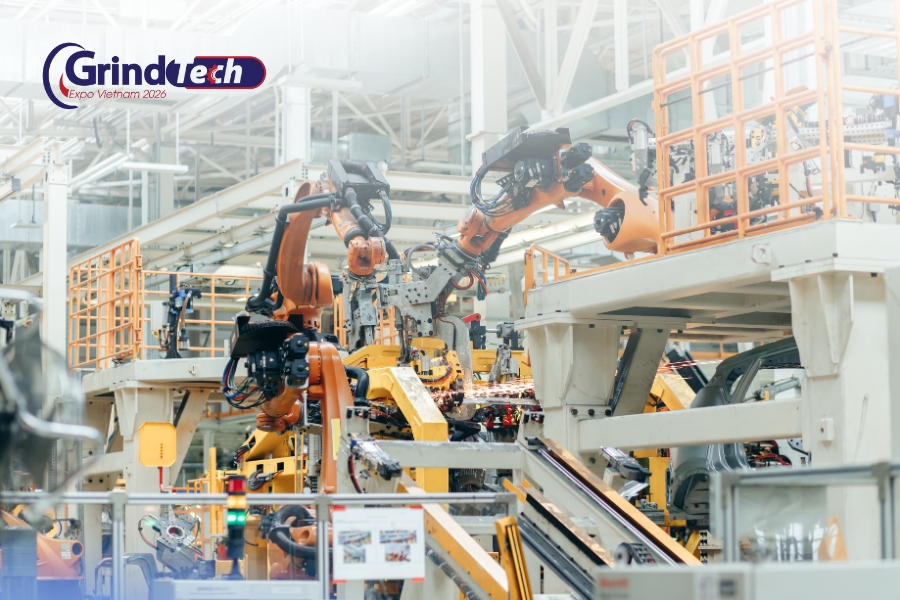
Robotic Grinding – A High-Precision Solution for Performance and Efficiency
Robotic grinding refers to automated systems that use industrial robots combined with grinding wheels, abrasive belts, or finishing tools to perform processes such as rough grinding, fine grinding, edge rounding, deburring, and surface polishing.
Key advantages of robotic grinding include:
- Near-perfect accuracy: minimizing human-induced variations
- High repeatability: ideal for large-scale, continuous manufacturing
- Improved worker safety: reducing exposure to dust, heat, vibration, and sparks
- Long-term cost efficiency: thanks to optimized tool wear, controlled force, and stable operating cycles
Industries with ultra-strict surface quality requirements, namely automotive, aerospace, mould manufacturing, medical devices, are rapidly shifting toward robotic grinding to ensure uniformity and compliance.
Global Trend – Robotic Grinding Market Growth
According to industry reports from Verified Market Reports and other global research publications, the robotic grinding market was valued at approximately USD 1.2 billion in 2024, and is projected to reach USD 2.4-2.8 billion by 2032–2033, representing a CAGR of around 10.2% from 2026 onward.
What is driving this rapid growth?
- Increasing production demands: Automated robotic cells ensure consistent surface quality and eliminate human variability.
- Tighter global tolerance standards: Automotive, aerospace, and medical sectors require high-precision finishing that robots can deliver more reliably.
- Skilled labor shortages: Many regions face a lack of experienced workers for manual grinding tasks, automation becomes a practical solution.
- ESG & energy-efficiency pressure: Robotic systems minimize waste, optimize energy usage, and extend tool life, supporting “green manufacturing” and sustainability goals.
Asia-Pacific: The Fastest-Growing Region
Market analyses consistently show the Asia-Pacific (APAC) region leading the growth curve, driven by expanding manufacturing bases in China, Vietnam, and India. Favorable investment conditions, export demand, and competitive production costs continue to position APAC as the global hub for robotic grinding adoption.
Applications in Vietnam – The Right Time to Automate
Vietnam is emerging as a manufacturing powerhouse in sectors such as automotive parts, electronics, precision engineering, and metal furniture. These industries increasingly require high surface quality, tight tolerances, and energy-efficient processes, making automated grinding systems a strategic investment.
Factories in Vietnam are transitioning from manual grinding to automated systems due to clear benefits in:
- Operational cost reduction
- Consistent output and higher product quality
- Improved workplace safety
- Better compliance with export standards (EU/US)
High-demand segments include:
- Automotive components & parts
- Electronics and semiconductor parts
- Mould and precision engineering
- Metal, steel and stainless-steel furniture manufacturing
The shift also aligns with Vietnam’s move toward cleaner, smarter, and ESG-aligned manufacturing.
Key Benefits for Vietnamese Manufacturers
Implementing robotic grinding and automated finishing systems offers comprehensive advantages:
- Lower production costs through reduced manual labor and fewer surface defects
- Higher compliance with EU/US export requirements
- ESG alignment by reducing noise, dust, and energy consumption
- Improved supply-chain positioning, meeting the expectations of global OEMs and FDI partners
- Automation has now become a strategic accelerator for Vietnam’s manufacturing and machining industries.

Automation at Grind Tech Expo Vietnam 2026
Automation and robotic grinding are no longer experimental technologies, they have become essential components of modern production. Investing in robotic grinding systems, force-control sensors, CNC-integrated solutions, and smart manufacturing technologies enables companies to:
- Enhance product quality
- Reduce operational and material costs
- Meet ESG and export requirements
- Strengthen global competitiveness
Grind Tech Expo Vietnam 2026 will serve as a key platform where manufacturers can discover real solutions, explore new technologies, connect with international suppliers, and build long-term automation strategies.
Book your stand at: https://checkin.veas.com.vn/book-a-stand/PRC2027/forms/gte?locale=en